Zuсi, group of Native Americans who live in a pueblo on the Zuсi Indian Reservation near Zuni, New Mexico. The Zuсi constitute a distinct linguistic family. In physical appearance, culture, and social organization they closely resemble other town-dwelling Native Americans such as the Hopi. Like them, the Zuсi are noted for their weaving, basketry, and pottery making, as well as for their turquoise jewellery. They farm the arid soil of the region using traditional irrigation methods.
The Zuсi have a strong attachment to ancient religious rituals, which are tied closely to the changing seasons, and include special devotion to the rain god. A tightly organized priest caste exercises great power over the people.
Present-day Zuсi are descended from the inhabitants of the seven Zuсi towns encountered in 1539 by the Franciscan missionary Marcos de Niza and called by the Spanish the Seven Cities of Cнbola. Although he had seen one of the villages only from a distance, de Niza reported that the Zuсi possessed fabulous riches, and in 1540 the Spanish explorer Francisco Vбsquez de Coronado led a military expedition to the Seven Cities. He conquered the Zuсi but found no treasure. Although a Christian mission was established among them in 1629, the Zuсi maintained their traditional religion. In 1680, when they numbered about 2,500, the Zuсi joined the successful Pueblo uprising against the Spanish, who subjugated them again in 1692.
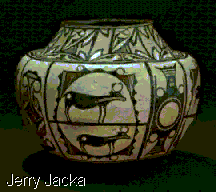
Zuсi Storage Jar |
Pottery making is an old and respected tradition among the Zuсi people of North America. This storage jar from the early 1900s was made using the "coil" method, in which long, thin coils of clay are formed around a flat, circular base and built up to create the shape of the jar, then smoothed and glazed. The white background with black and brown geometric designs is characteristic of Zuсi pottery. |